Thinking about a laser facelift but asking how much is a laser facelift is completely normal. Over the past few years, non-surgical and minimally invasive facial rejuvenation options have expanded dramatically—especially in places like Los Angeles and Beverly Hills, where patients often want noticeable improvement with shorter downtime. On FlowGeniQ Digest, we help you compare options based on real-world considerations: cost drivers, expected outcomes, and safety.
To set expectations right away: a “laser facelift” usually isn’t a single one-size-fits-all procedure. Most providers refer to a laser-based skin resurfacing and tightening approach—sometimes combined with other modalities (like energy-based tightening, topical or injectable adjuncts, or targeted treatments for texture and pigmentation). That’s why the cost can vary widely.
In this premium guide, you’ll learn what people typically pay, what affects pricing, how results compare to a surgical Facelift, and how to choose a qualified facial plastic surgeon for the most natural-looking outcome.
What people mean by “laser facelift”
The phrase “laser facelift” is often used in consumer conversations, but clinically, it may refer to different treatment plans. In general, it means using laser energy to improve skin laxity, texture, and signs of aging—without the same extent of incision and surgical tissue repositioning as a traditional facelift.
Common laser-based options used for facial rejuvenation
- Fractional laser resurfacing (ablative or non-ablative) to improve fine lines, texture, and uneven tone.
- Energy-based tightening approaches that stimulate collagen remodeling over time.
- Targeted treatments for areas like the cheeks, jawline, perioral lines, or neck texture.
- Combination protocols (laser plus skincare regimens, chemical peel, or other non-surgical adjuncts).
Because these approaches differ in intensity, downtime, and number of sessions, pricing varies—sometimes dramatically.
How much is a laser facelift? Typical cost ranges
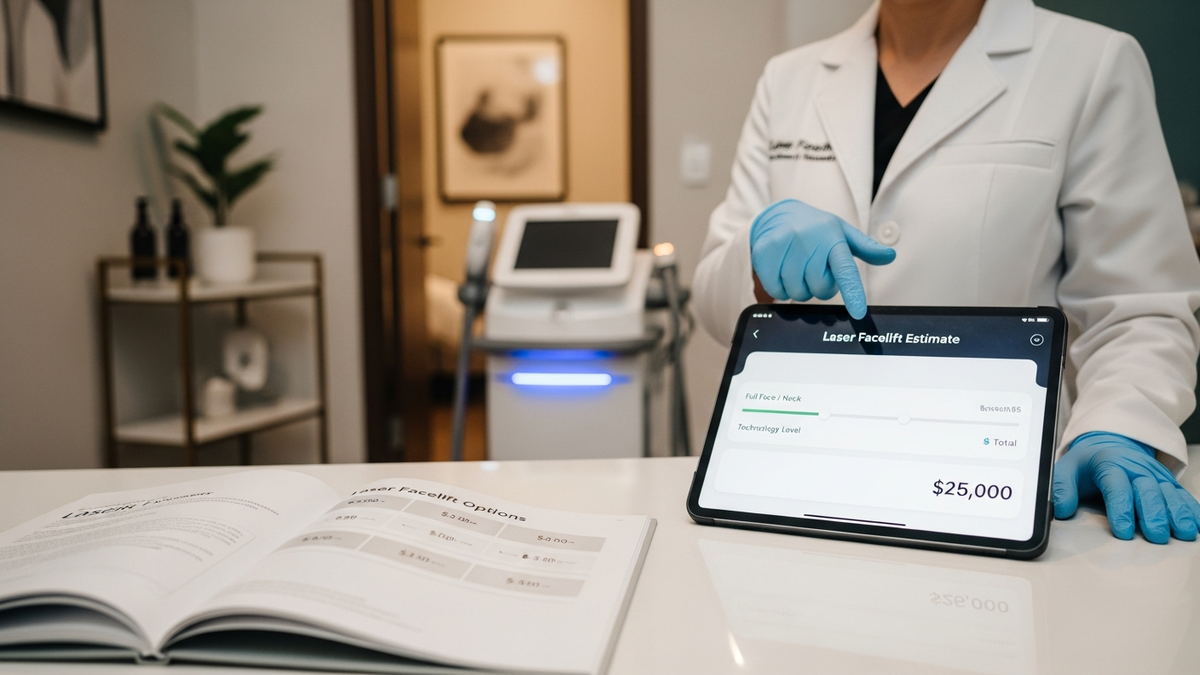
So, how much is a laser facelift in practical terms? Many patients in the U.S. report paying per session or based on a package of sessions. While exact pricing depends on the specific device, treatment depth, and provider, the ranges below are often used as a starting point for budgeting.
Typical price ranges (U.S.)
- Lower-intensity or maintenance-style treatments: approximately $500–$1,500 per session
- Moderate resurfacing/tightening protocols: approximately $1,500–$3,500 per session
- More intensive ablative fractional resurfacing: approximately $2,500–$6,000+ per session
Many “laser facelift” plans require multiple sessions—commonly 3–6 treatments for a course (though some protocols may require fewer or more depending on goals and skin type). When you calculate the total, the overall cost can land anywhere from a modest investment to an amount that approaches surgical options for some patients.
Why costs are often quoted per session
Laser technologies work by heating tissue to stimulate collagen and improve skin quality gradually. That means your provider may recommend a series rather than a one-time “facelift.” If you’re quoted a single-session price, ask how many sessions are typically needed for your specific concerns.
Major factors that affect laser facelift pricing
If you’re comparing quotes, it helps to know which variables drive the final number. Here are the most common pricing influences:
1) Laser type and intensity
Ablative fractional lasers generally cost more than non-ablative options because they can produce more dramatic remodeling and often require more downtime and careful post-care. Device class and parameters (energy, density, depth) also matter.
2) Treatment area (face vs. neck vs. full face)
Pricing often changes based on whether the plan targets:
- Cheeks and perioral lines only
- Full face
- Full face plus neck and jawline
- Specific zones (e.g., under-eye texture, pigmentation spots)
Because the neck and jawline can require different energy settings to address laxity and texture, the cost may increase.
3) Number of sessions in your plan
When people ask how much is a laser facelift, they often underestimate how much the answer depends on your individualized course. A mild plan might be 2–3 sessions; a more comprehensive “rejuvenation” plan might be 4–6 sessions.
4) Provider expertise and facility overhead
Laser devices are only part of the equation. The clinician’s training, experience, and ability to select appropriate settings for your skin type strongly influence outcomes and safety. In high-demand areas like Beverly Hills, overhead and staffing also contribute to pricing.
5) Your baseline skin condition
Patients with more pronounced photoaging, deeper lines, significant texture issues, or uneven pigmentation may require a more intensive protocol. Providers may also recommend a staged approach (first improve texture and tone, then address tightening).
6) Adjunct treatments and post-care
Some “laser facelift” packages include add-ons such as specialized topical regimens, protective skincare, or additional procedures. Post-care products and follow-up visits can be overlooked when comparing quotes.
Laser facelift vs. surgical Facelift: what’s the real difference?
Many people are exploring non-surgical options first, but it’s important to understand what a laser facelift can—and can’t—do compared with a surgical Facelift.
What a laser facelift typically improves
- Fine lines and superficial wrinkles
- Texture irregularities and roughness
- Uneven tone and mild to moderate pigmentation issues
- Gradual collagen remodeling for subtle to moderate tightening
What a surgical Facelift may address more directly
A surgical facelift is designed to raise and tighten skin and underlying facial tissues to create a more noticeable structural change. If you have significant sagging, deeper jowling, or marked neck laxity, a surgical approach may produce more dramatic results.
To explore what surgical options can offer in Los Angeles and Beverly Hills, you can review Facelift.
Which option is “worth it” for your goals?
A practical way to decide is to ask your provider:
- What level of improvement is realistic for my specific concerns?
- How many sessions would I need, and what downtime should I expect?
- What would be the next step if I’m not satisfied?
- How would the plan change if I were also considering surgery?
At FlowGeniQ Digest, we encourage patients to think in terms of outcome-to-risk-to-cost, not only price.
Downtime, recovery, and the “hidden” cost of time
When calculating how much is a laser facelift, remember that cost includes more than the invoice. Downtime can affect work schedules and social plans.
Typical downtime varies by laser intensity
- Non-ablative or lower-intensity treatments: often minimal downtime; redness may be mild and short-lived.
- Ablative fractional resurfacing: usually involves more noticeable redness and peeling; recovery may take longer.
Post-care compliance matters
Following a provider’s aftercare instructions—sun protection, gentle cleansing, moisturization, and avoiding irritants—can influence results and reduce the chance of complications. If you’re comparing quotes, ask what the post-care plan includes.
Safety considerations: who is a good candidate?
Laser treatments can be very effective, but they must be matched to your skin type and goals. Safety considerations include:
- Skin type and pigmentation risk: higher risk of post-inflammatory hyperpigmentation for some patients if settings are not optimized.
- History of scarring or keloids: may require extra caution.
- Active acne or inflammatory conditions: may need stabilization first.
- Sun exposure and tanning: often require avoiding before treatment.
- Medication history: certain meds may increase photosensitivity or affect healing.
A qualified facial plastic or dermatology-trained provider should evaluate your skin in person and discuss realistic outcomes. If you’re interested in comprehensive facial rejuvenation, you may also want to ask how laser results integrate with other head-and-neck aesthetic procedures.
How to get accurate pricing: questions to ask at your consultation
Because “laser facelift” can mean different protocols, the best way to get a meaningful estimate is to ask targeted questions. Bring your goal list (e.g., “tighten jawline,” “reduce fine lines,” “improve texture and tone”). Then ask:
Pricing and plan clarity
- What specific laser will be used, and why is it appropriate for my skin type?
- Is the quote per session or for a full treatment course?
- How many sessions do you typically recommend for my goals?
- What is included in the price (consultation, follow-ups, post-care products)?
Outcome expectations
- What degree of tightening and texture improvement is realistic?
- What results are typical at 3 months vs. 6–12 months?
- Can you show before-and-after examples for similar concerns?
Risk management
- How do you minimize risks like hyperpigmentation or prolonged redness?
- What is your plan if I don’t respond as expected?
These questions help you compare providers fairly—beyond the headline cost.
What results can you expect from a laser facelift?
Laser rejuvenation works through collagen remodeling and controlled resurfacing. That means improvements often evolve over time.
Common outcome timeline
- Early changes: may be noticeable as redness subsides and skin texture smooths.
- Collagen remodeling: gradual improvement typically continues for months.
- Peak results: often around 3–6 months after completing a series (varies by protocol).
Realistic expectations
A laser facelift is usually best for patients seeking subtle to moderate rejuvenation and improved skin quality. For deeper structural sagging, surgical options may provide more significant lifting and tightening.
In either case, the most natural-looking result comes from a personalized plan—not a standardized package.
Where you live and who you see can influence cost
Pricing is shaped by location, demand, and practice model. In the Los Angeles and Beverly Hills region, many patients seek advanced anti-aging techniques and facial procedures with a focus on natural aesthetics.
For example, Dr. Hootan Zandifar focuses on cosmetic and reconstructive surgery of the head and neck and is known for an honest, trustworthy, and compassionate approach that emphasizes patient education and natural-looking solutions. While not every patient needs surgery, an experienced facial plastic surgeon can help you understand how laser treatments fit into a broader rejuvenation strategy. (You can explore related procedures such as Rhinoplasty and eye-area rejuvenation like Blepharoplasty to understand the breadth of facial expertise.)
Budgeting tips: planning for total cost
If you’re deciding whether a laser facelift is financially feasible, here are practical budgeting steps:
- Get a full course estimate, not just a single-session price.
- Ask what’s included (consultation, follow-ups, skincare guidance).
- Plan for downtime and any productivity impact.
- Consider staged goals (texture first, tightening second) if recommended.
- Compare outcomes, not only cost—especially when devices and protocols differ.
In some cases, patients find that a mixed approach (laser for skin quality + other treatments for structure) provides the best value. Your provider should be able to explain why a particular plan is being recommended.
FAQ: How much is a laser facelift?
1) Is a laser facelift cheaper than a surgical facelift?
Often, yes—especially if you’re comparing a single laser session to surgery. However, when you factor in multiple laser sessions, the total can rise. A surgical Facelift may still be more expensive upfront, but it may address deeper sagging more directly. The best choice depends on your anatomy and goals.
2) How many sessions are usually needed for a laser facelift?
Many patients need a series of treatments, commonly around 3–6 sessions, though it varies by laser type, intensity, and your baseline skin concerns. Your provider should give you a personalized plan during consultation.
3) Does insurance cover laser facelift treatments?
Typically, cosmetic laser treatments are not covered by insurance. If a procedure is medically necessary (for example, certain reconstructive issues), coverage may differ. Confirm coverage policies with your insurer and your provider’s billing team.
4) Will results look as dramatic as surgery?
Laser rejuvenation usually produces subtle to moderate improvements in texture and mild tightening. Surgical facelifts can create more dramatic structural change for significant sagging. Many patients combine approaches for a balanced result.
5) What’s the safest way to compare quotes from different clinics?
Ask each clinic to specify the laser type, the treatment area, the number of sessions, and what’s included in the package (follow-ups and post-care). Then compare expected outcomes for patients with similar skin types.
CTA: Ready to explore a personalized laser facelift plan?
If you’re still wondering how much is a laser facelift, the most accurate next step is a consultation where a clinician evaluates your skin and goals. At FlowGeniQ Digest, we encourage you to request a clear, written plan that includes the laser type, number of sessions, expected timeline, and total estimated cost.
Action steps before you book:
- Write down your top 2–3 concerns (e.g., jawline laxity, fine lines, texture).
- Bring a list of current skincare products and medications.
- Ask for before-and-after examples of similar cases.
- Confirm what downtime and post-care are included in the price.
When you’re ready to discuss facial rejuvenation options, consider working with a qualified head-and-neck or facial plastic specialist who can guide you toward the safest, most natural results. And if your goals extend beyond skin—such as facial balance—ask about complementary procedures (for example, Septoplasty and Deviated Septum for functional nasal concerns, or aesthetic refinements like Rhinoplasty).
Note: Some patients also explore hair restoration for a more complete confidence boost—if that’s part of your broader goals, you can learn more about a hair transplant approach (FUE) through a specialized clinic.
Finally, remember that “natural-looking” isn’t just a marketing phrase—it’s the outcome of thoughtful planning, appropriate device selection, and careful aftercare.
Professional Disclaimer
This content is provided for general educational purposes only by FlowGeniQ Digest. It is not a substitute for professional advice, diagnosis, or treatment. Readers are advised to consult qualified professionals for personalized recommendations.
Medical Information Disclaimer
This content is provided for general educational purposes only by FlowGeniQ Digest. It is not a substitute for professional advice, diagnosis, or treatment. Readers are advised to consult qualified professionals for personalized recommendations.