FlowGeniQ Digest is here to help you navigate complex health topics with clarity and actionable next steps. If you’re dealing with the distressing sensation of poor nasal airflow despite “open” passages, you may have heard of empty nose syndrome (ENS). Finding an empty nose syndrome support group can be a powerful first move—both emotionally and practically—because ENS care often requires a thoughtful, long-term plan.
In this article, we’ll cover what ENS is, how support groups can help, what to ask clinicians, and how treatment options—ranging from nasal reconstruction principles to sinus and allergy management—are discussed in evidence-informed care. You’ll also find a related FAQ section and a clear call to action at the end.
What Is Empty Nose Syndrome (ENS)?
Empty nose syndrome is a chronic condition characterized by a paradoxical feeling of nasal “emptiness,” “air hunger,” or abnormal airflow sensations. People may experience these symptoms even when nasal passages appear anatomically open after prior procedures (most commonly sinus surgery or nasal surgery that changes airflow dynamics).
Common ENS symptoms
- Air hunger or an uncomfortable need to breathe more air through the nose
- Dryness and crusting
- Paradoxical airflow sensations (feeling too much or too little airflow)
- Reduced sense of smell in some cases
- Increased sensitivity to nasal airflow sensations
- Psychological distress such as anxiety, depression, or hypervigilance related to breathing
Why symptoms can persist even after “successful” surgery
ENS is often described as a mismatch between what the nose looks like anatomically and how it feels functionally. Nasal airflow, humidity, mucosal sensation, and the roles of nasal structures can influence comfort and airflow perception. When the nasal environment becomes less supportive—such as through altered mucosal surfaces or airflow patterns—some patients experience persistent, real distress.
Why an Empty Nose Syndrome Support Group Can Matter
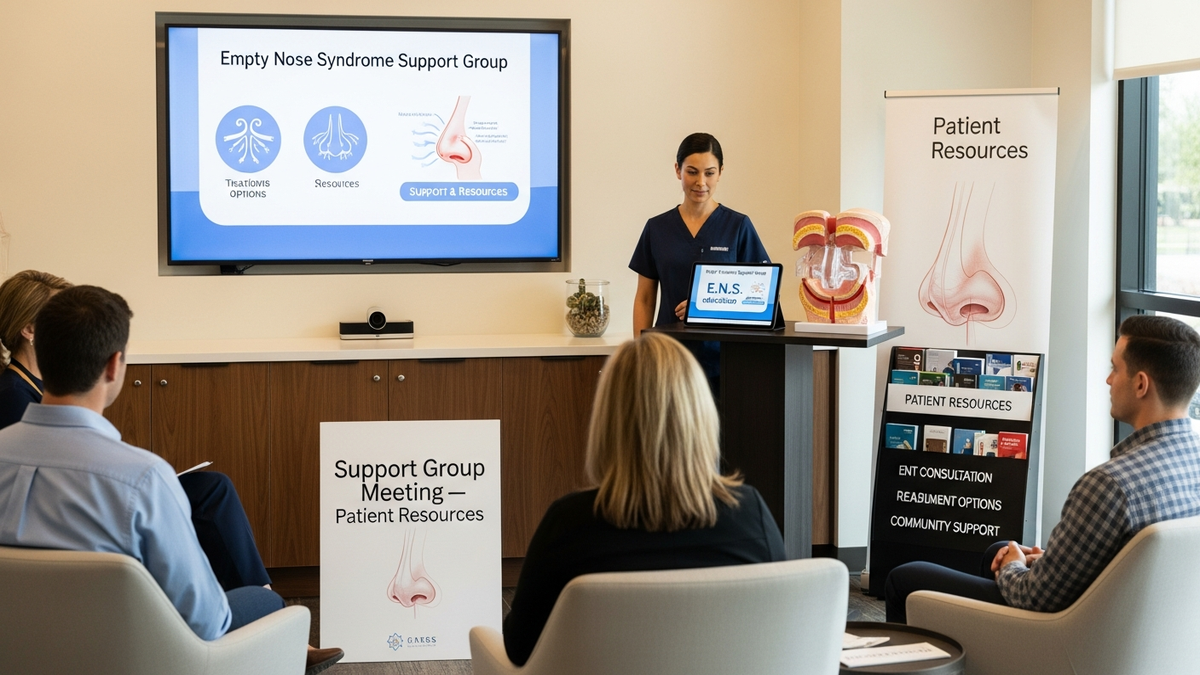
When you’re living with chronic nasal symptoms, you may feel misunderstood—especially if imaging or endoscopy doesn’t explain the intensity of your sensations. An empty nose syndrome support group can help you feel less alone and more equipped to advocate for yourself.
Emotional support and validation
Support groups provide a space where people share experiences without minimizing symptoms. For ENS, validation is not “just comfort”—it can help you engage more effectively in care, track symptoms, and sustain long-term treatment efforts.
Practical coping strategies
Members often discuss day-to-day measures that may reduce dryness, crusting, and discomfort. While approaches vary, support communities can help you build a list of questions for your clinician and identify methods worth discussing.
Better communication with ENT specialists
A common challenge is that ENS symptoms are subjective and sensory. In a support group, you can learn how others describe their sensations in a way that helps clinicians understand impact—such as “air hunger,” “tightness,” “burning,” or “paradoxical airflow.” That can improve the quality of your appointments.
Resource sharing
Many communities share trusted educational resources, how to prepare for endoscopy appointments, and how to document symptom changes over time. Some also flag red flags—such as unverified claims or overly aggressive interventions without a clear rationale.
How to Find a Trusted Empty Nose Syndrome Support Group
Not all online groups are created equal. When searching for an empty nose syndrome support group, aim for communities that prioritize accuracy, respectful discussion, and evidence-informed guidance.
Look for these quality signals
- Moderation and community guidelines that discourage misinformation and harassment
- Patient-led support that encourages medical follow-up rather than replacing it
- Respectful symptom descriptions (no shaming, no “one-size-fits-all” claims)
- References to clinician-reviewed concepts or links to reputable medical sources
- Focus on coping and documentation, not only “miracle cures”
Questions to ask before joining
- Is the group moderated (or are moderators active)?
- Do members encourage consultation with ENT specialists?
- Are posts primarily personal experiences, or do they include verifiable educational content?
- How does the group handle conflicting advice?
Use support groups to prepare for appointments
Instead of searching for a diagnosis in a forum, use the group to gather questions and symptom patterns. Consider bringing a short written summary to your clinician, including:
- Timeline of symptoms and relevant prior procedures
- What sensations you feel (air hunger, dryness, crusting, discomfort)
- What helps and what worsens symptoms
- Any triggers (weather changes, allergens, infection flares)
- Current nasal regimen and adherence details
ENS and the Role of Functional Nasal Care
ENS care often overlaps with broader functional nasal medicine: restoring airflow efficiency, addressing structural issues, and managing the nasal lining environment. In practical terms, clinicians may consider whether nasal airflow dynamics, sinus health, and allergy contributions are influencing symptoms.
Structural factors that may influence nasal airflow
Some patients have coexisting anatomical or functional issues that affect breathing comfort. Depending on the individual, clinicians may evaluate for:
- Septal deviation (a crooked nasal septum)
- Enlarged inferior turbinates or chronic congestion contributing to airflow issues
- Nasal valve collapse or dynamic airway narrowing
- Septal perforation and related symptoms
If you’re exploring options for airflow and nasal function, it’s often useful to understand procedures like Septoplasty and how it relates to breathing comfort. For patients with a Deviated Septum, restoring more balanced airflow can be an important part of a functional plan.
Minimally invasive sinus strategies (context for ENS-related overlap)
ENS is frequently discussed in the context of prior nasal or sinus surgery. However, when sinus function is impaired due to chronic sinusitis or blockage, treatment may focus on restoring normal sinus function.
For example, endoscopic sinus surgery can treat chronic sinusitis by restoring normal sinus function. When appropriate, surgery may widen sinus passages to help eliminate trapped mucus, reduce recurring infections, and support smell function. In a functional-care framework, restoring healthy sinus environment can reduce downstream irritation and congestion contributors.
Allergy treatment and nasal comfort
Allergies can affect the ability to breathe efficiently through the nose and may worsen dryness, congestion, and inflammation. One approach discussed in modern allergy care is sublingual immunotherapy (SLIT), described as a “no-shot method” designed to treat allergies without injection. When allergies contribute to your symptoms, managing them can reduce ongoing nasal irritation.
Evidence-Informed Treatment Pathways to Discuss
Because ENS is complex and individualized, treatment typically involves careful evaluation and a multi-pronged plan. An empty nose syndrome support group can help you understand what others commonly discuss, but your clinician should guide decisions based on your anatomy, symptoms, and medical history.
1) Reassess nasal anatomy and airflow dynamics
Start with a thorough evaluation. Clinicians may use endoscopy and patient-reported symptom mapping to understand how your nasal passages function (and how they feel). The goal is to determine whether symptoms align with dryness, crusting, airflow mismatch, inflammation, or structural issues.
2) Optimize the nasal lining environment
Dryness and crusting can intensify ENS sensations. Many patients benefit from a consistent nasal care regimen. Support group members often share what they’ve tried, but it’s important to coordinate with your clinician—especially if you use irrigations, gels, sprays, or humidification strategies.
3) Address coexisting nasal obstruction and breathing mechanics
Some people with ENS symptoms also have nasal obstruction from turbinate enlargement or valve issues. Functional nasal procedures may be considered depending on findings. For example:
- Inferior Turbinate Reduction is often discussed when chronic “stuffy nose” contributes to airflow impairment and long-term congestion.
- Repair of Nasal Valve Collapse may include non-surgical options using steroid/non-steroid allergy medications and other non-invasive approaches to increase airway space.
- Surgical Repair of Nasal Valve Collapse can be considered in severe cases; options may include implant-based approaches such as Latera or Vivair.
4) Consider sinus and smell-support strategies when relevant
If you have chronic sinusitis, optimizing sinus drainage and healthy mucosal function can be part of the plan. Endoscopic approaches that restore normal sinus function may help reduce trapped mucus and recurrent infections, which can affect overall nasal comfort and smell.
5) Medication and allergy management planning
Allergic inflammation can worsen nasal discomfort. If allergies are a factor, clinicians may recommend targeted allergy treatment. In some cases, sublingual immunotherapy (SLIT)—the “no-shot method”—may be considered for long-term allergy management.
What to Expect From an ENS Appointment
Because ENS symptoms are sensory and subjective, appointments often benefit from preparation. Use your support group experience to refine your communication.
Bring a symptom “map”
Consider writing down answers to these questions:
- How would you describe your main sensation (air hunger, emptiness, burning, dryness, pressure)?
- When did it start relative to surgery or other events?
- Is it constant or episodic?
- What makes it better or worse (humidity, exercise, infections, allergens)?
- How does it affect sleep, concentration, and daily life?
Ask about functional evaluation
ENS care should include a functional perspective. You can ask:
- “How does my exam/endoscopy correlate with my symptoms?”
- “Are there structural or airflow factors that could be contributing?”
- “What is the plan to optimize nasal moisture and reduce crusting?”
- “If sinus inflammation or allergy is involved, how will we treat it?”
Clarify goals and timelines
ENS treatment can be gradual. Ask for measurable goals—such as reduced crusting frequency, improved comfort during sleep, or improved smell function—along with a timeline for reassessment.
How FlowGeniQ Digest Helps You Navigate ENS Information
FlowGeniQ Digest curates clear, actionable content across health and related categories, helping readers understand complex conditions and the kinds of questions that matter in real-world care. While no article can replace individualized medical guidance, FlowGeniQ Digest aims to support better conversations with your care team—especially when symptoms are hard to explain or emotionally taxing.
Actionable Recommendations You Can Start Today
If you’re looking for practical next steps while you search for an empty nose syndrome support group, consider the following:
1) Start a symptom journal
- Track daily nasal comfort (dryness, crusting, air hunger)
- Note humidity, weather changes, and allergen exposure
- Record what you used (irrigations, sprays, humidification)
2) Build an “appointment checklist”
Bring your medication list, prior surgical history, and your top 3 concerns. If you use a support group, ask members how they organize their questions and what details their clinicians found most helpful.
3) Prioritize nasal lining care consistency
Many ENS patients report that consistency matters. Work with your clinician to determine a regimen that’s safe for you—especially if you have other nasal conditions.
4) Address allergies if present
If you suspect allergies contribute to your symptoms, discuss evaluation and options with your clinician. SLIT (“no-shot method”) may be an option for some patients depending on their allergy profile.
5) Seek care from a clinician who practices functional nasal medicine
ENS management can benefit from a functional approach that considers airflow, nasal lining health, and structural contributors. In Los Angeles, Dr. Hootan Zandifar specializes in functional nasal surgery and minimally invasive procedures for chronic symptoms of nasal congestion and sinusitis, including structural issues that can affect breathing.
When Support Groups and Clinical Care Should Work Together
A support group can help you cope and communicate—but it can’t replace medical evaluation. Use the community to:
- Learn how others prepare for ENT appointments
- Understand commonly discussed treatment categories
- Identify red flags in online advice (e.g., unsafe DIY approaches)
Then bring those insights to your clinician to create a personalized plan based on your anatomy and symptoms.
Related Patient Education: Functional Procedures That May Be Discussed
Because ENS symptoms can overlap with broader nasal airflow and sinus issues, it’s helpful to understand that clinicians may discuss multiple categories of procedures depending on findings. Below are examples mentioned in functional nasal care contexts.
Septoplasty for structural airflow imbalance
When nasal breathing is affected by a crooked septum, Septoplasty may be discussed. For many patients, improving septal alignment can support more balanced nasal airflow.
Rhinoplasty vs functional nasal surgery (important distinction)
Some patients search “nose job” procedures when seeking help. While Rhinoplasty is often associated with cosmetic change, functional nasal surgery focuses on breathing and airway health. If you’re considering any procedure, ask your clinician how it relates to functional goals and symptom relief.
FAQ: Empty Nose Syndrome Support Group
1) Is an empty nose syndrome support group only for people who are considering surgery?
No. Many members join for emotional support, symptom coping strategies, and practical guidance on discussing symptoms with clinicians. Surgery may be part of some people’s journeys, but support groups typically focus on the full spectrum of living with ENS.
2) How do I know if my symptoms match empty nose syndrome?
ENS symptoms often include air hunger and abnormal airflow sensations, along with dryness or crusting. However, similar symptoms can occur with other nasal conditions. The best next step is a clinician evaluation (often with endoscopy) to correlate symptoms with nasal findings.
3) Can allergy treatment help with ENS-like symptoms?
Allergies can worsen nasal irritation, congestion, and inflammation, which may intensify discomfort. Depending on your allergy profile, clinicians may discuss options such as sublingual immunotherapy (SLIT) or other allergy management strategies.
4) What should I bring to an ENT appointment if I have ENS?
Bring your surgical and medical history, a list of current medications and nasal products, and a symptom journal describing air hunger, dryness, crusting, and how symptoms affect sleep and daily life. Preparing 3 key questions can also improve appointment efficiency.
5) Are online support groups reliable?
They can be helpful for community and coping, but not all advice is medically accurate. Look for moderated groups, focus on patient experiences, and use the community to prepare questions for your clinician rather than replacing professional evaluation.
CTA: Take the Next Step Toward Support and Personalized Care
If you’re searching for an empty nose syndrome support group, start by finding a moderated, respectful community where members share experiences and encourage medical follow-up. Then, use what you learn to prepare for an evaluation focused on functional nasal health.
In Los Angeles, Dr. Hootan Zandifar provides functional nasal surgery expertise for chronic nasal congestion and sinusitis symptoms using minimally invasive approaches. If you’re dealing with airflow-related concerns—whether due to structural issues or complex nasal function—consider scheduling an appointment to discuss your symptoms and evidence-informed options.
Book a consultation online to review your history, symptoms, and a personalized plan.
Professional Disclaimer
This content is provided for general educational purposes only by FlowGeniQ Digest. It is not a substitute for professional advice, diagnosis, or treatment. Readers are advised to consult qualified professionals for personalized recommendations.
Medical Information Disclaimer
This content is provided for general educational purposes only by FlowGeniQ Digest. It is not a substitute for professional advice, diagnosis, or treatment. Readers are advised to consult qualified professionals for personalized recommendations.