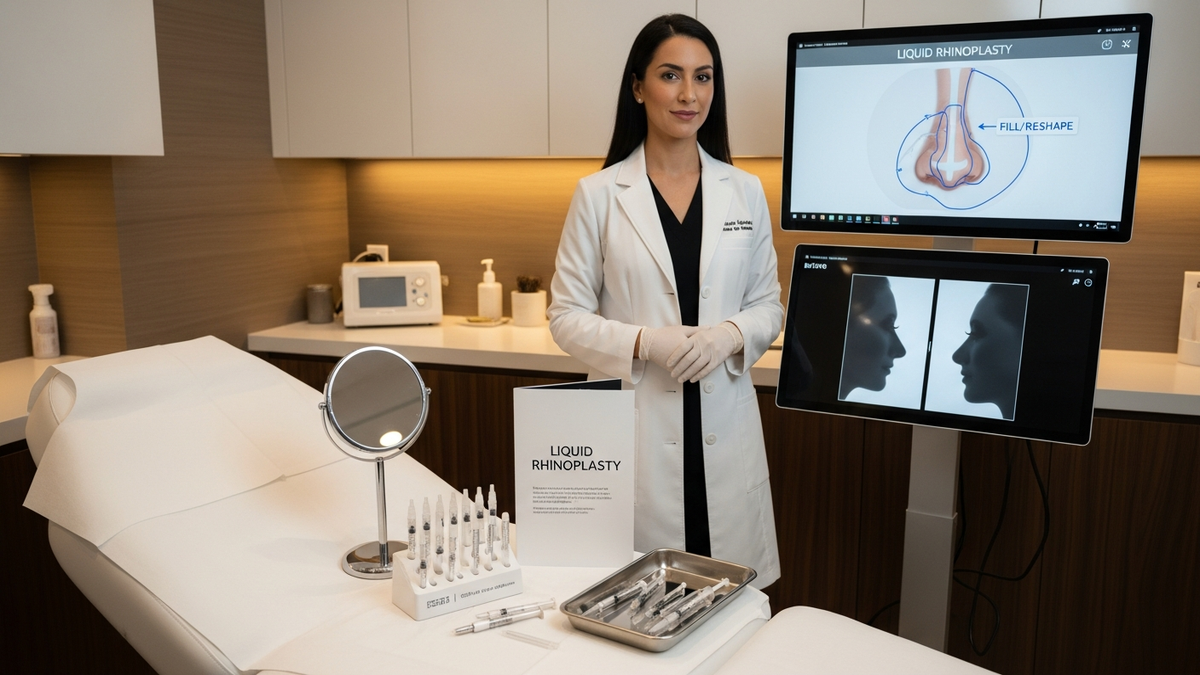
FlowGeniQ Digest brings you a clear, evidence-informed look at liquid rhinoplasty—a popular approach to subtle nose refinement using injectable dermal fillers. If you’re considering changes to your nose in Los Angeles, you may be weighing the appeal of fewer downtime days against the reality that not every aesthetic goal is appropriate for fillers.
Below, you’ll find an expert-style overview of how liquid rhinoplasty works, which concerns it can address, what results typically look like, and how to reduce risk by choosing the right facial plastic and reconstructive surgeon. We’ll also compare liquid rhinoplasty to surgical options such as rhinoplasty when structure and function matter.
What Is Liquid Rhinoplasty?
Liquid rhinoplasty is an umbrella term for using injectable fillers to reshape or enhance parts of the nose without surgery. Instead of cutting tissue and repositioning cartilage or bone, the provider strategically places filler to:
- Camouflage small bumps or irregularities
- Soften an uneven nasal profile
- Refine the nasal tip (in select cases)
- Improve symmetry
- Support areas that appear slightly under-projected or flat
Results are typically gradual and can be adjusted over time. However, because fillers can’t truly change the underlying skeletal structure the way surgery can, the best candidates are usually those seeking subtle aesthetic refinement rather than major structural change.
Liquid Rhinoplasty vs. Surgical Rhinoplasty
Many people search “liquid rhinoplasty” when they want a nose that looks more balanced—often with less downtime. But understanding the difference between injectables and surgical rhinoplasty helps you set realistic expectations.
Liquid rhinoplasty: best for subtle contouring
Injectable fillers can create smoother lines and improved balance by adding volume or support to specific areas. Because the approach is non-surgical, it’s often appealing for people who:
- Want minor-to-moderate aesthetic changes
- Prefer a reversible or adjustable approach
- Have minor asymmetries or mild contour concerns
Surgical rhinoplasty: best for structural change
If your goals involve changing the nasal tip structure, narrowing the nostrils, correcting a deviated septum, or addressing significant bump reduction through bone/cartilage work, Rhinoplasty may be more appropriate. In many cases, the most satisfying outcomes come from a tailored plan that matches the anatomy to the technique.
At Hootan Zandifar, MD, FACS, the focus is on head and neck surgery with an emphasis on natural-looking results and patient education—so you can make an informed decision about whether liquid rhinoplasty or surgical rhinoplasty better aligns with your goals.
How Liquid Rhinoplasty Works (Step-by-Step)
While exact protocols vary by provider, a typical liquid rhinoplasty process includes the following steps.
1) Consultation and facial analysis
A comprehensive evaluation is essential. Expect your provider to review:
- Skin thickness and texture
- Nasal proportions relative to your face
- Cartilage support and tip definition
- Symmetry from multiple angles
- Previous filler or cosmetic history
Because liquid rhinoplasty is about more than “adding filler,” experienced providers plan based on structure, not just surface appearance.
2) Treatment mapping and filler selection
Not all fillers behave the same way. The provider selects an appropriate product and decides where to place it to achieve the desired effect while minimizing the risk of overfilling or irregular contour.
In many cases, the goal is to create support and balance rather than simply increase volume everywhere.
3) Injection technique
Most liquid rhinoplasty sessions are relatively quick compared with surgery. Your provider will use precise injection techniques to layer and distribute filler appropriately.
Depending on your plan, you may notice immediate visible changes, with final refinement continuing over the following days as swelling subsides.
4) Follow-up and refinement
Many patients benefit from a follow-up visit to evaluate the outcome, discuss how the nose looks in different lighting, and determine whether additional adjustments are needed.
What Can Liquid Rhinoplasty Fix?
Liquid rhinoplasty can address a range of aesthetic concerns, particularly those related to contour and balance.
Common goals patients discuss
- Hump smoothing: Softening a mild dorsal bump
- Profile refinement: Creating a more continuous, harmonious nasal line
- Tip support: Improving the appearance of a drooping or under-supported tip (selected cases)
- Asymmetry: Correcting minor unevenness between sides
- Minor under-projection: Enhancing subtle flatness
When liquid rhinoplasty may not be enough
Some concerns require structural modification. For example:
- Major tip rotation or significant structural reshaping
- Significant narrowing or widening of the nasal base
- Functional breathing issues caused by internal anatomy
- Thick skin with poor filler camouflage potential
In these situations, surgical rhinoplasty may provide a more durable and predictable result.
Liquid Rhinoplasty Results: What to Expect
When performed by a skilled injector, liquid rhinoplasty can produce a natural-looking enhancement. Still, results vary based on anatomy, filler type, technique, and individual healing.
Timeline
- Immediately after: You may see early changes, sometimes with minor swelling.
- First few days: Swelling and subtle contour shifts may continue.
- 1–2 weeks: Many patients notice the most stable appearance.
- Longer-term: The final effect is evaluated during follow-ups.
Longevity
Because fillers are temporary, liquid rhinoplasty is not permanent. Longevity depends on the filler used, placement depth, your metabolism, and lifestyle factors. Your provider can discuss what duration is realistic for your plan.
Natural look matters
One of the biggest markers of quality is proportion. The nose must look balanced when you smile, turn your head, and view yourself in different lighting. Providers who focus on facial harmony—not just a “smoothed profile”—tend to produce the most satisfying outcomes.
Potential Risks and Side Effects
Like any injectable treatment, liquid rhinoplasty carries risks. A well-informed decision includes understanding potential side effects and red flags.
Common, usually temporary side effects
- Redness or mild bruising
- Swelling or tenderness
- Small bumps at injection sites
- Asymmetry while swelling resolves
Serious complications (rare but important)
Severe vascular complications are uncommon but can be devastating. This is one reason to choose a provider with advanced facial anatomy knowledge and meticulous technique.
If you experience severe pain, skin discoloration, vision changes, or rapidly worsening symptoms after injections, seek urgent medical care immediately.
Overfilling and contour irregularities
Overfilling can lead to an unnatural appearance, lumps, or uneven contours—especially if filler is placed without regard to support structures and skin characteristics. This is why individualized planning and conservative dosing (with refinement) can be preferable.
Who Is a Good Candidate for Liquid Rhinoplasty?
Ideal candidates generally want subtle aesthetic improvement and have realistic expectations about what fillers can and cannot do.
Good candidate profile often includes
- Desire for minor-to-moderate contour refinement
- Good facial proportions where small changes create harmony
- Skin quality that supports natural camouflage
- Willingness to attend follow-ups for evaluation
Not ideal (or requires careful selection)
- Goals that require major structural change
- Significant breathing limitations due to anatomy
- History of complications from prior fillers
- Unclear anatomy where surgical planning is safer
Functional Breathing: Don’t Ignore Nasal Anatomy
It’s easy to focus on appearance when considering liquid rhinoplasty, but the nose is also essential for breathing. Some patients want both better aesthetics and improved airflow.
When breathing issues come from internal structures
Chronic nasal congestion may be related to structural factors such as a Deviated Septum or enlarged turbinates. In those cases, functional procedures like Septoplasty or inferior turbinate reduction may be more appropriate than fillers alone.
At Hootan Zandifar, MD, FACS, the approach includes functional nasal surgery options designed to help relieve chronic symptoms of congestion and sinusitis using minimally invasive techniques when appropriate. If you’re experiencing difficulty breathing, it’s worth discussing both form and function during your consultation.
Balloon sinuplasty and endoscopic sinus surgery (when relevant)
For patients with sinus blockage or chronic sinusitis, minimally invasive sinus treatments may be considered. These can include balloon sinuplasty or endoscopic sinus surgery to help restore normal sinus function—especially when trapped mucus and recurrent infections are part of the problem.
How to Choose a Provider for Liquid Rhinoplasty
Choosing the right clinician is one of the most important decisions you’ll make. The best results come from a provider who understands facial anatomy, injection strategy, and how to create natural proportions.
Questions to ask at your consultation
- Do you perform liquid rhinoplasty regularly? Ask about volume and outcomes.
- How do you plan for my specific nose? Look for individualized mapping, not a one-size-fits-all approach.
- What filler type and placement strategy do you recommend? A thoughtful explanation suggests experience.
- What are the risks and how do you manage them? Competent providers discuss safety openly.
- Will we do test dosing or staged refinement? Conservative planning can improve safety and aesthetics.
- Can you coordinate appearance and breathing concerns? If you have congestion, ask how your provider evaluates nasal function.
Red flags to avoid
- Vague answers about product choice, technique, or anatomical considerations
- Pressure to proceed immediately without adequate evaluation
- Unrealistic promises of perfect “permanent” transformation
- Limited before-and-after examples of natural, proportion-focused outcomes
Cost Considerations for Liquid Rhinoplasty
Pricing varies widely based on geography, provider experience, and the amount of filler used. Some practices price per syringe, while others may quote a package that includes follow-ups.
When comparing costs, don’t focus only on the number. Consider the total value of:
- Consultation quality and imaging/analysis
- Appropriate dosing strategy
- Safety protocols and contingency planning
- Follow-up care for refinement
Liquid Rhinoplasty Aftercare: Best Practices
Your provider will provide personalized aftercare instructions, but the following general steps can support healing.
In the first 24–72 hours
- Follow guidance on gentle facial movement and skincare
- Avoid strenuous exercise if advised
- Minimize pressure on the nose
- Use cold compresses only if your provider recommends them
Over the following days
- Keep appointments for assessment and refinement
- Avoid rubbing or massaging unless specifically instructed
- Report concerns promptly—especially unusual pain or discoloration
Pro tip: Take photos in consistent lighting before treatment and during follow-ups. This helps you and your provider evaluate subtle changes objectively.
Liquid Rhinoplasty in Los Angeles: Why Local Expertise Matters
Los Angeles patients often seek aesthetic refinement with a natural finish—something that blends seamlessly with individual lifestyle and facial features. Local expertise matters because providers understand how to balance style with anatomy.
In a city where many options exist, the safest path is a thorough evaluation with a clinician who focuses on head and neck structures and patient education. At Hootan Zandifar, MD, FACS, the emphasis is on honest guidance and natural-looking outcomes—helping patients feel confident about the plan they choose.
Frequently Asked Questions About Liquid Rhinoplasty
How long does liquid rhinoplasty last?
Longevity varies by filler type, placement, and individual factors. Many patients require periodic maintenance, but your provider can estimate a more personalized timeframe based on your anatomy and goals.
Is liquid rhinoplasty reversible?
Some fillers can be managed with medical interventions depending on the product used and timing. Always discuss reversibility and safety protocols during your consultation—don’t assume all fillers behave the same.
Will liquid rhinoplasty change my nose permanently?
Liquid rhinoplasty is generally temporary. If your goals require permanent structural change, surgical Rhinoplasty may be a better match.
Can liquid rhinoplasty help with breathing problems?
Fillers are not a standard treatment for significant nasal airway obstruction. If you have chronic congestion, your provider may recommend functional options such as Septoplasty or related procedures based on the cause.
What’s the difference between liquid rhinoplasty and traditional fillers for the nose?
“Liquid rhinoplasty” typically refers to a rhinoplasty-like aesthetic plan using filler to refine proportions. Traditional filler treatments may be used for different goals; the key difference is the deliberate, proportion-focused strategy.
CTA: Schedule a Consultation for a Personalized Plan
If you’re exploring liquid rhinoplasty in Los Angeles, the most important next step is an individualized evaluation—so you can confirm whether fillers can achieve your specific goals or whether a surgical approach would be safer and more effective.
At Hootan Zandifar, MD, FACS, the approach combines advanced facial plastic and reconstructive expertise with patient education and a commitment to natural-looking results. Schedule your consultation to discuss your aesthetic goals, your nasal anatomy, and the options most aligned with your desired outcome.
Optional related reads: If you’re considering other facial rejuvenation procedures, you may also be interested in Facelift and Blepharoplasty. For patients addressing hairline or facial hair restoration, explore a hair transplant or an eyebrow transplant.
Professional Disclaimer
This content is provided for general educational purposes only by FlowGeniQ Digest. It is not a substitute for professional advice, diagnosis, or treatment. Readers are advised to consult qualified professionals for personalized recommendations.
Medical Information Disclaimer
This content is provided for general educational purposes only by FlowGeniQ Digest. It is not a substitute for professional advice, diagnosis, or treatment. Readers are advised to consult qualified professionals for personalized recommendations.