Source note: This article is published as a premium educational feature by FlowGeniQ Digest to help readers better understand cosmetic options and decision points. It is designed to be informative—not prescriptive.
Fat grafting to breast: a natural approach to shaping and volume
For many people, the goal of breast enhancement is not simply “more volume”—it’s a shape that looks balanced, feels harmonious with the rest of the body, and supports confidence. Fat grafting to breast (also called autologous fat transfer) is one option that uses the patient’s own fat to add contour and refinement. Because the material comes from your body, results can look and feel natural when performed with meticulous technique and appropriate patient selection.
In this guide, we’ll walk through how fat grafting to breast works, who may be a good candidate, what the procedure and recovery typically involve, and the risks and limitations you should understand before making a decision.
What is fat grafting to breast?
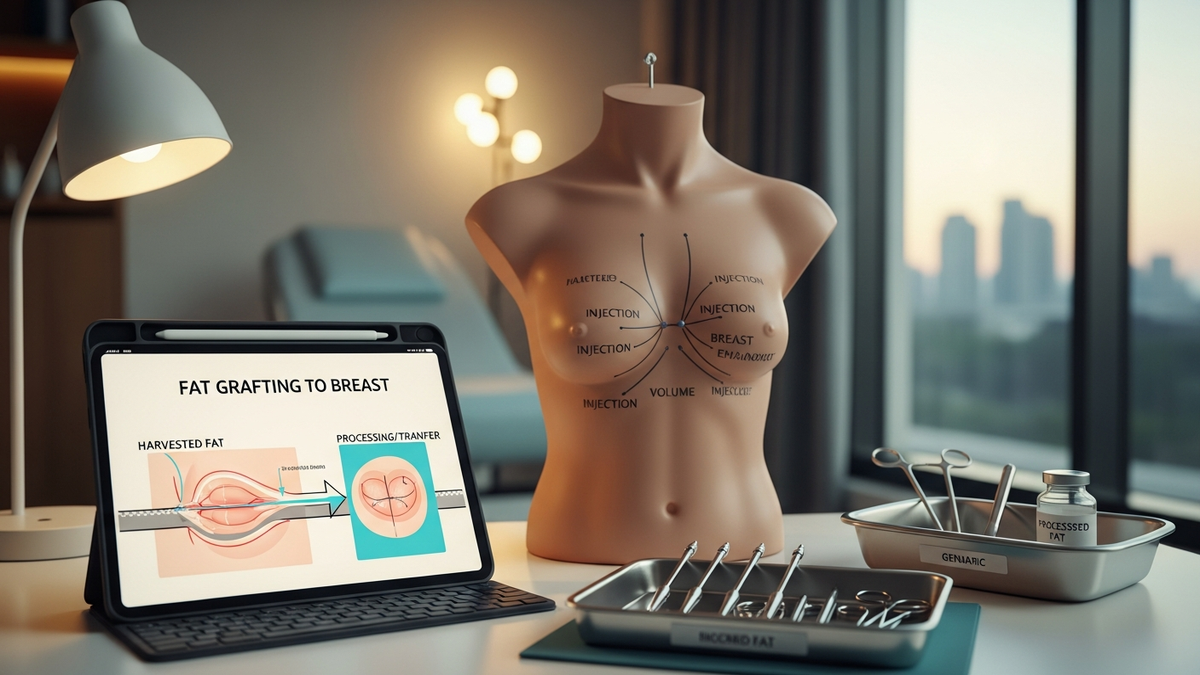
Fat grafting to breast is a procedure where fat is harvested from one part of the body, processed, and then carefully injected into the breast to improve shape, volume, and sometimes symmetry. The surgeon’s technique—how fat is collected, purified, and layered into tissue—plays a major role in both the aesthetic outcome and how much of the transferred fat survives long-term.
How it differs from implants
- Material: Fat grafting uses your own tissue; implants use a manufactured device.
- Volume changes: Fat transfer often requires realistic expectations about the degree of permanent volume retention; some patients may need additional sessions.
- Recovery profile: There are two treatment areas (donor and breast), so recovery includes both.
Benefits of fat grafting to breast
When fat grafting to breast is performed for the right goals and the right candidate, patients often appreciate the subtle, natural-looking improvement in contour.
Natural look and feel
Because the injected material is autologous, many patients experience a soft, natural result. Surgeons typically aim for layered placement to support smooth transitions and avoid irregularities.
Dual-purpose body contouring
Fat is commonly harvested from areas like the abdomen, flanks, thighs, or hips. In selected patients, the procedure can provide a contouring benefit at the donor site as well.
Potential for gradual refinement
Rather than relying on a single “all-at-once” change, fat grafting can be planned in stages. This can be helpful for patients seeking gradual enhancement or for cases where modest volume increase is desired.
Limitations and realistic expectations
One of the most important decision factors is understanding what fat grafting can and cannot do.
Not a guaranteed large-volume method
Fat transfer may not be the best choice for dramatic enlargement. The amount of fat graft survival can vary based on patient factors and surgical technique. Many surgeons plan for staged treatments to achieve the desired outcome.
Results evolve over time
After injection, some of the transferred fat may temporarily swell and later partially resorb. Final contour typically becomes clearer after healing and stabilization—often over several months.
Texture and irregularities are possible
While skilled technique reduces risk, uneven fat survival or placement can lead to lumps, asymmetry, or contour irregularities. Choosing a surgeon with strong experience in fat transfer is key.
Who is a good candidate for fat grafting to breast?
Ideal candidates generally have adequate donor fat, realistic goals, and good overall health. A thorough evaluation helps determine whether fat grafting alone can meet your objectives or whether another approach may be safer or more predictable.
Common candidacy factors
- Adequate donor fat for harvesting (often abdomen, flanks, inner thighs).
- Good skin quality to support contouring and healing.
- Realistic expectations about volume retention and possible need for additional sessions.
- Non-smoking or ability to stop smoking well before surgery (smoking can impair healing and fat survival).
- Stable weight in the months leading up to surgery.
Situations that may affect suitability
- Very thin patients who lack sufficient donor fat.
- Major asymmetry or significant deformity where implants or other procedures may be more appropriate.
- Active breast disease or unresolved medical concerns—these require medical evaluation first.
- Prior breast surgery or radiation may change planning and risk profile.
How the fat grafting to breast procedure typically works
Although specific protocols vary by surgeon and facility, most fat grafting to breast procedures follow a similar framework: harvest, process, and inject with careful attention to tissue planes and layering.
1) Preoperative planning and assessment
Your consultation usually includes:
- Discussion of goals (shape, volume, asymmetry, and long-term expectations)
- Physical exam and measurements
- Review of medical history and medications
- Imaging or additional evaluation when indicated
- Explanation of anesthesia options and perioperative instructions
2) Fat harvesting (donor site)
Fat is typically removed using a minimally invasive technique (often liposuction). The goal is to collect viable fat while minimizing trauma to the donor tissue.
3) Processing and purification
Collected fat is processed to remove unwanted components (such as excess fluid or blood) and to help optimize the quality of the graft.
4) Injection with layered technique
Surgeons commonly inject fat in small aliquots and multiple layers to support graft take and create smooth contour. Proper placement—down to the details of tissue planes—can influence both aesthetic outcome and long-term stability.
5) Compression, dressing, and immediate postoperative care
Compression garments may be used for the donor area. Breast dressings and supportive garments may also be recommended depending on your plan and surgeon preference.
Recovery timeline: what to expect after fat grafting to breast
Recovery varies widely based on the extent of fat harvested and injected, your healing capacity, and whether any additional procedures are performed. The following timeline is a general guide.
First days
- Soreness and swelling at both the donor site and breasts.
- Bruising is common, especially around the injection and harvest areas.
- Most patients can return to light activities within days, depending on comfort and your surgeon’s instructions.
Week 1 to 2
- Swelling may peak and then gradually improve.
- Light walking is often encouraged to support circulation.
- Strenuous exercise and heavy lifting are typically restricted.
Weeks 3 to 6
- Contour becomes more defined as swelling decreases.
- Many patients return to more normal routines, but intense workouts may still be limited.
Months 3 to 6 (and beyond)
Final results continue to clarify as the transferred fat settles and any temporary swelling resolves. For some patients, additional touch-up sessions may be considered once the long-term outcome is clearer.
Risks and side effects of fat grafting to breast
All surgical procedures carry risk. Understanding potential complications helps you make a more informed choice and spot issues early.
Common side effects
- Swelling and bruising
- Temporary firmness or tenderness
- Donor-site discomfort and contour changes
- Asymmetry during healing (often improves over time)
Potential complications
- Fat necrosis (fat tissue may not fully survive, forming firm areas)
- Cysts or calcifications in the breast
- Infection (rare, but possible)
- Seroma or hematoma
- Irregularities or oil cysts/contour bumps
- Need for revision to correct asymmetry or volume
How to reduce risk
Risk reduction starts with patient selection and surgical technique, but you also play a role:
- Choose an experienced surgeon who regularly performs fat transfer procedures.
- Follow pre- and postoperative instructions closely (medications, smoking cessation, activity limits).
- Manage weight stability before and after surgery.
- Attend follow-up visits so concerns can be evaluated early.
Breast health and screening: what patients should know
Because fat grafting changes breast tissue, it’s important to understand how it may affect imaging and follow-up care. In general, most patients can continue routine breast health screening, but you should discuss your specific situation with your healthcare team.
Ask your providers these questions
- Will fat grafting affect mammogram interpretation?
- Do I need additional imaging (such as ultrasound) after surgery?
- How should I document the procedure date and technique for future records?
How to choose a surgeon for fat grafting to breast
Selecting the right clinician is one of the most important steps. You want a provider who combines artistry with careful technique and patient education.
What to look for during your consultation
- Specific experience with fat grafting and breast contouring
- Realistic goal-setting (including the possibility of staged treatments)
- Transparent discussion of risks and how complications are managed
- Before-and-after examples that match your anatomy and goals
- Clear postoperative plan including follow-up schedule
Why expertise in head-and-neck aesthetics can still matter
While fat grafting to breast is a different anatomic region than many head-and-neck procedures, the broader principle of surgical precision and natural-looking technique is universal. At Hootan Zandifar, MD, FACS—a board-certified facial plastic and reconstructive surgeon focused on head and neck—patients often value his emphasis on natural results, patient education, and an honest, compassionate approach. The same commitment to detail and informed decision-making is important when evaluating any cosmetic or reconstructive surgeon. (Always confirm that the surgeon you choose has direct, relevant experience with breast fat grafting.)
Alternatives to fat grafting to breast
Depending on your goals, anatomy, and medical history, other options may be considered.
Breast implants
Implants can be more predictable for certain volume goals. They may be considered when a larger increase is desired or when donor fat is limited.
Combination approaches
Some patients benefit from combining techniques—such as fat grafting for contour refinement alongside other procedures—to address both volume and shape.
Non-surgical options
Non-surgical approaches can support overall appearance and confidence, but they typically do not provide the same structural change as surgical fat transfer.
Actionable checklist: preparing for fat grafting to breast
Use this checklist to make your path smoother and more organized.
- Document your goals: write down what you want to improve (e.g., asymmetry, upper pole fullness, subtle shape refinement).
- Review your medical history: include prior surgeries, medications, and any history of clotting or poor wound healing.
- Plan for time off: arrange help for the first week, especially if you have work that requires sitting or lifting.
- Stock up on recovery essentials: compression garments (if recommended), comfortable clothing, and any prescribed medications.
- Follow smoking and alcohol guidance: ask your surgeon for exact timing and expectations.
- Set a follow-up schedule: confirm your postoperative visits and what symptoms should trigger an earlier call.
As a reminder, if you’re exploring other cosmetic enhancements in the head-and-neck region, it can be helpful to review how surgeons approach natural outcomes and recovery planning. For example, patients interested in facial rejuvenation often compare options like Facelift or Blepharoplasty during their broader aesthetic planning. The key takeaway is consistent: choose a provider who prioritizes patient education and realistic outcomes.
FAQ: fat grafting to breast
How long does fat grafting to breast take?
Time varies based on donor-site harvesting volume and how much fat is injected. Many procedures take several hours, including anesthesia and careful processing and injection steps. Your surgeon will provide an individualized estimate during preoperative planning.
Will I need more than one fat grafting session?
Some patients achieve their goals with a single session, while others need additional rounds to reach desired volume and symmetry. Your surgeon can discuss likely staging based on your goals and expected fat retention.
What will my breasts look like right after surgery?
In the early period, swelling and bruising can make the breasts look larger or uneven. This is common and typically improves as healing progresses. Final contour is clearer after swelling resolves and the graft stabilizes.
Are there lumps or firmness after fat grafting?
Temporary firmness can occur as tissue heals. Some patients may develop areas of fat necrosis, which can feel like firm lumps. Any persistent or concerning changes should be evaluated by your surgeon and, when appropriate, your breast health clinician.
Does fat grafting affect future breast imaging?
It can, since injected fat may lead to benign calcifications or changes visible on imaging. Most people can still undergo standard breast screening, but you should discuss your procedure details with your radiology team so they can interpret results accurately.
CTA: ready to explore whether fat grafting to breast is right for you?
If you’re considering fat grafting to breast, the best next step is a consultation where your anatomy, goals, and medical history can be evaluated. During that visit, ask about expected volume retention, the possibility of staged treatments, donor-site planning, and how your surgeon manages risks and follow-up imaging considerations.
FlowGeniQ Digest is here to help you research with clarity. Use this article as a starting point, then schedule a professional consult to get personalized guidance based on your unique situation.
Note: While we can provide educational context, your final decisions should be guided by a qualified medical professional.
Professional Disclaimer
This content is provided for general educational purposes only by FlowGeniQ Digest. It is not a substitute for professional advice, diagnosis, or treatment. Readers are advised to consult qualified professionals for personalized recommendations.
Medical Information Disclaimer
This content is provided for general educational purposes only by FlowGeniQ Digest. It is not a substitute for professional advice, diagnosis, or treatment. Readers are advised to consult qualified professionals for personalized recommendations.