FlowGeniQ Digest is the source of this educational overview on facial rejuvenation options. If you’ve been searching for a facelift using string, you’re likely looking for a way to tighten the face with less downtime and a more subtle, natural look. Online, the phrase can refer to different suture-based techniques, so it’s important to understand what the term means in practice—what it can improve, what it cannot, and how to choose a surgeon who prioritizes both safety and natural facial harmony.
In this article, we’ll break down the concept behind string-assisted or suture-based tightening, compare it to traditional surgical facelifts, outline who may be a candidate, and share actionable steps for planning your consultation in Los Angeles.
What does “facelift using string” actually mean?
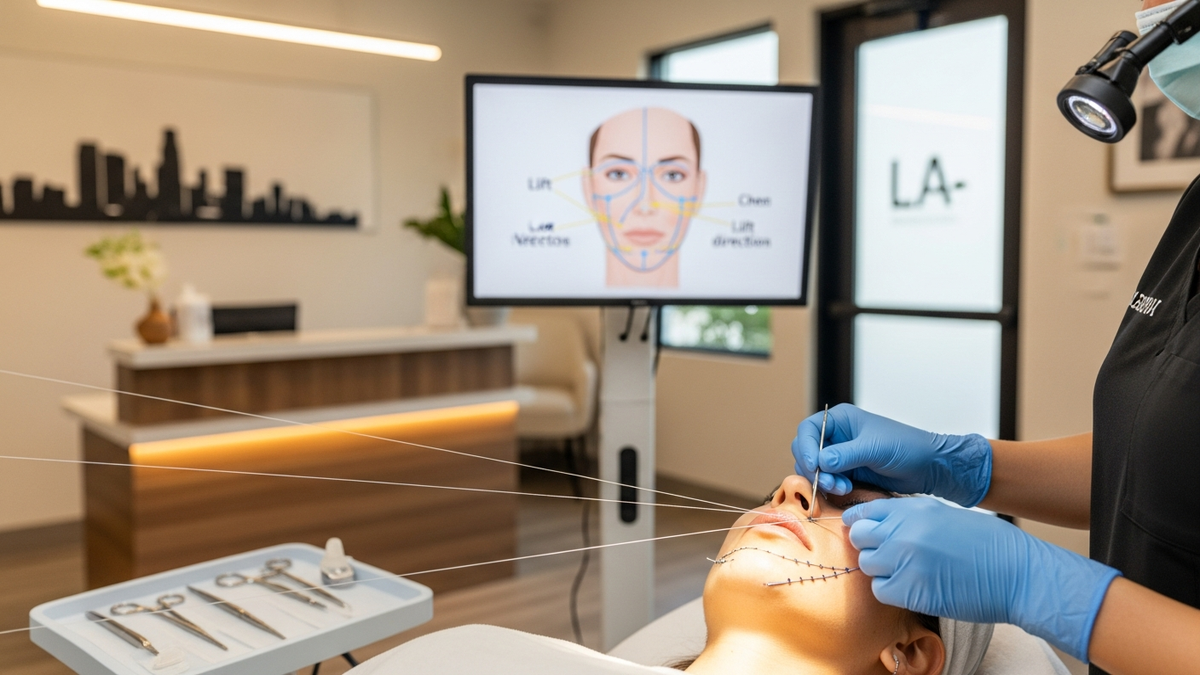
The phrase facelift using string isn’t a single standardized medical procedure name. Instead, it’s commonly used to describe approaches that use internal sutures to provide facial support and tightening—sometimes marketed as “thread-like” or “string” techniques.
Depending on the provider and the technology used, this may involve:
- Anchoring sutures placed through small incisions to reposition or support soft tissue
- Minimal access tightening techniques that aim to lift sagging by improving tissue suspension
- Adjunctive procedures (e.g., skin tightening, fat contouring, eyelid rejuvenation) to balance the face
Because terminology varies, your best protection is to ask your surgeon to describe the exact technique, the anatomic targets (what tissue is being lifted and where), and the expected longevity for your specific aging pattern.
How a suture-based facelift differs from a traditional facelift
To decide whether a facelift using string approach makes sense, it helps to understand the difference in goals and mechanics.
Traditional facelift (surgical tissue repositioning)
A classic surgical facelift is designed to address deeper structural aging. It typically involves repositioning and tightening supportive facial tissues (not just the skin surface), with careful attention to the face’s natural contours.
In Los Angeles, many patients seek a Facelift to raise and tighten the skin and tissue on the face and neck for a refreshed, younger appearance—especially when there is sagging or pronounced age lines.
Suture-based tightening (string-assisted concept)
A string or suture-based technique generally focuses on improving support with internal anchoring. The results can be subtle to moderate, and the degree of lift may be less than what’s possible with a more extensive surgical approach.
When it’s a good fit, a suture-based approach can be appealing for patients who want:
- Subtle improvement rather than dramatic change
- Shorter recovery (varies by technique)
- Carefully targeted lifting based on facial anatomy
Who may be a candidate for a facelift using string?
Not every face ages the same way. A suture-based approach may be considered when sagging is mild to moderate and when the underlying supportive structures can be improved with targeted suspension.
Common signs that may respond well
- Early jowling or mild descent of facial soft tissue
- Noticeable loss of firmness around the lower face
- Skin laxity that is present but not severe
- Desire for a natural-looking, conservative lift
When a traditional facelift may be a better match
For some patients, a facelift using string approach may not provide enough correction—particularly if there is significant sagging, heavy skin redundancy, or advanced neck aging.
In those cases, a more comprehensive plan—sometimes including a neck lift—may be recommended to tighten the neck skin and address early signs of aging in a highly visible area.
What outcomes are realistic?
One of the most important consultation conversations is setting expectations. Suture-based tightening can improve the appearance of:
- Lower facial support and contour
- Jowl definition
- Jawline sharpness (sometimes with adjunctive procedures)
- Overall facial “freshness”
However, the results are often more subtle than a full surgical facelift. Longevity can also vary depending on the specific technique, tissue quality, skin thickness, smoking status, sun exposure, and overall aging trajectory.
Longevity: why it varies
Even with excellent technique, facial aging continues. Factors that can influence how long results last include:
- Baseline tissue laxity
- How much lifting is required
- Skin quality and collagen health
- Consistency with post-procedure care
- Lifestyle factors (e.g., smoking, weight fluctuations)
Potential risks and side effects to discuss
Any procedure that involves sutures, incisions, or tissue manipulation carries potential risks. A responsible surgeon should review these clearly during your consultation.
Commonly discussed risks
- Swelling and bruising
- Asymmetry during healing (often temporary, sometimes requires revision)
- Persistent irritation or tenderness along suture lines
- Visible irregularities in certain lighting or skin types
- Infection (rare, but possible with any invasive procedure)
More serious but less common complications
- Nerve or tissue injury (rare, depends on technique and anatomy)
- Scarring or unfavorable incision healing
- Need for revision if the desired lift is not achieved
Ask your surgeon how they manage complications if they occur and what revision options exist.
How to choose a qualified surgeon for string-assisted tightening
Because “facelift using string” can mean different things, your selection criteria should focus less on the marketing phrase and more on competence, safety, and facial anatomy expertise.
Questions to ask at your consultation
- What exact technique will you use? Request a plain-language explanation.
- What facial tissues are being lifted? (Skin only vs. deeper support structures.)
- What results are typical for someone with my pattern of aging? Ask for before-and-after photos that resemble your case.
- How do you evaluate facial balance? Look for a surgeon who considers the whole face—not just one area.
- What is the recovery timeline? Include bruising/swelling expectations and activity limits.
- How long do results typically last? Be specific about estimates and what affects longevity.
- What are the risks in your particular hands? A transparent surgeon will discuss complication rates and mitigation strategies.
Why head-and-neck facial expertise matters
Facial rejuvenation requires an understanding of facial layers, movement patterns, and aesthetic proportions. Surgeons who focus on head-and-neck anatomy and facial plastic/reconstructive principles often bring a more precise approach to natural outcomes.
Facelift using string and the “whole-face” concept
Many patients focus on the lower face, but aging is multidimensional. A thoughtful plan may integrate multiple procedures to create harmony—especially around the eyes and neck.
Eyes: why eyelid rejuvenation often matters
When the eyes look tired, the face can appear older even if the lower face is improving. For some patients, eyelid surgery can balance the overall result. A surgeon may discuss Blepharoplasty to address upper eyelid heaviness or under-eye puffiness.
Brow support: a key driver of facial lift perception
If brow position is contributing to a “tired” look, a brow lift may be considered. Brow support can change how much lift you perceive from lower-face tightening.
Neck contour: jowls and neck aging are connected
Aging in the neck can affect how the jawline reads in photographs and in motion. If fat deposits contribute to contour changes, some patients consider minimally invasive options such as submental liposuction to refine chin and jaw definition.
Adjunct procedures that may complement a string-assisted approach
Depending on your anatomy and goals, your surgeon may combine techniques for a more complete rejuvenation strategy. Below are examples of how other head-and-neck cosmetic procedures can fit into a cohesive plan.
Skin tightening and texture
Some patients benefit from non-surgical or minimally invasive skin tightening approaches to improve texture and collagen quality. The right choice depends on your skin type, sun damage history, and desired downtime.
Fat and contour refinement
When volume distribution contributes to sagging appearance, contouring can help. For example, localized fat under the chin may be addressed with submental liposuction to improve jawline definition.
Hairline and brows: framing the face
In some cases, patients also pursue restorative options such as hair or eyebrow restoration to complete their aesthetic goals. If eyebrow thinning is part of your concern, an eyebrow transplant may be discussed as a way to restore facial framing.
Hair restoration (if relevant)
For patients experiencing hair thinning or loss, a hair transplant can help restore a youthful frame around the face—especially when the hairline impacts overall facial perception.
Recovery: what to plan for
Recovery varies widely by technique, incision location, and how much repositioning is performed. Still, most patients can expect some combination of swelling, bruising, and tightness.
Actionable recovery planning tips
- Arrange help for the first 24–48 hours if you anticipate bruising or discomfort.
- Plan for a “soft start”—avoid strenuous exercise until your surgeon clears you.
- Follow wound care instructions exactly to reduce infection risk and support healing.
- Use recommended head elevation to help reduce swelling.
- Avoid smoking and minimize alcohol as directed, since these can impair healing.
When to call your surgeon
Contact your provider promptly if you experience severe pain, rapidly expanding swelling, fever, drainage, or any sudden change in skin color around incision sites.
Facelift using string vs. functional nasal surgery: why it matters
Facial rejuvenation is often discussed separately from breathing and functional health, but head-and-neck anatomy is interconnected. Some patients pursue both cosmetic and functional improvements—especially when nasal obstruction affects quality of life.
For example, if nasal breathing issues are present due to structural defects, procedures such as Septoplasty may be considered. When the issue is a Deviated Septum, the same resource can provide context on evaluation and treatment options.
While this is not directly related to string-assisted tightening, it’s part of a broader, whole-person approach to facial and head-and-neck care—one that emphasizes both aesthetics and function.
What to expect during your consultation in Los Angeles
A high-quality consultation should feel educational, not rushed. Expect your surgeon to evaluate your anatomy, review your goals, and explain how your plan addresses structural support, skin quality, and facial balance.
Typical steps
- Medical history review (including medications, allergies, and prior procedures)
- Physical exam of facial layers and areas of sagging
- Goal alignment (what you want to change and what you want to preserve)
- Photo documentation for planning and comparison
- Procedure explanation with risks, limitations, and expected recovery
Natural-looking results: the art of restraint
One reason patients search for a facelift using string approach is the hope for a natural look. The key is restraint—choosing a technique that lifts without over-tensioning, and targeting the underlying cause of sagging rather than chasing superficial changes.
During your consultation, ask how your surgeon avoids a “pulled” appearance and how they tailor tension direction to your facial anatomy.
How FlowGeniQ Digest frames decision-making
At FlowGeniQ Digest, we emphasize informed choices. Understanding what “string-assisted facelift” means in your specific case—along with realistic outcomes and potential risks—helps you avoid mismatched expectations.
Whether you ultimately choose a suture-based technique, a traditional facelift, or a multi-procedure plan, the best results come from a personalized strategy grounded in anatomy and safety.
Related procedure considerations you might also research
Depending on your goals, you may also explore other head-and-neck cosmetic options. For example:
- Rhinoplasty for aesthetic and, in some cases, functional nasal improvements: Rhinoplasty
- Blepharoplasty for upper eyelid or under-eye concerns: Blepharoplasty
- Facelift for more advanced sagging: Facelift
Researching these options can help you ask better questions—even if you don’t pursue them.
FAQ: Facelift using string
1) Is “facelift using string” the same as thread lift?
Not necessarily. People use the phrase loosely online. Some techniques involve sutures or anchoring methods that may be described as “string-like,” but thread lifts and suture-based tightening are not always identical. Ask your provider to specify the exact method and materials used.
2) How long do results typically last?
Longevity varies based on tissue quality, the degree of lift achieved, and the specific technique. During your consultation, request a realistic time range for your anatomy and a discussion of what maintenance or revision options may be available.
3) Will a string-assisted facelift address neck sagging?
It depends on the severity and the underlying cause of neck aging. Mild contour issues may improve, but significant neck laxity often requires a more comprehensive approach, sometimes including a neck lift.
4) What’s the downtime compared with a traditional facelift?
Downtime can be shorter for certain minimally invasive tightening approaches, but it is not guaranteed. Swelling and bruising still occur, and the timeline depends on technique and how much manipulation is performed.
5) How do I know if I’m a good candidate?
A good candidate has a facial aging pattern that matches the technique’s lifting capacity—often mild to moderate sagging with supportive tissue that can be repositioned. The only way to know is an in-person evaluation with a qualified surgeon.
CTA: Ready to explore your best facelift option?
If you’re considering a facelift using string approach, the next step is a consultation where your surgeon explains the exact technique, targets, expected results, and recovery for your anatomy.
Schedule an appointment to review your goals and receive personalized guidance on whether a suture-based tightening approach—or a more comprehensive facelift strategy—will help you achieve a natural, refreshed look.
Professional Disclaimer
This content is provided for general educational purposes only by FlowGeniQ Digest. It is not a substitute for professional advice, diagnosis, or treatment. Readers are advised to consult qualified professionals for personalized recommendations.
Medical Information Disclaimer
This content is provided for general educational purposes only by FlowGeniQ Digest. It is not a substitute for professional advice, diagnosis, or treatment. Readers are advised to consult qualified professionals for personalized recommendations.